
The Stockholm Convention on Persistent Organic Pollutants is a Multilateral Environmental Agreement (MEA) to protect human health and the environment from Persistent Organic Pollutants (POPS). POPS are hazardous due to their longevity in the environment, resulting in wide geographic distribution and bioaccumulation in living organisms. The some of the main provisions of the convention are
read moreThe Basel Convention on the Control of Transboundary Movements of Hazardous Wastes and their Disposal is a Multilateral Environmental Agreement (MEA) with the main objective of protecting human health and the environment against adverse effects caused by hazardous or other wastes which require special consideration. The main provisions of the convention are to reduce the
read moreThe Basel Convention Regional Centre for Training and Technology Transfer for the Caribbean (BCRC-Caribbean) has developed a learning platform with self-paced online courses on the Stockholm Convention on Persistent Organic Pollutants (POPs) and their Management in the Caribbean. The courses were derived from outputs of the recently completed regional project funded by the Global Environment
read moreWaste electronic and electrical equipment, (WEEE) or e-waste, describes electrical and electronic devices that are nearing the end of their useful life, with no intention of reuse. E-waste is becoming a growing concern as it contains toxic components which, when improperly disposed of, can result in the exposure of the environment and living organisms to
read moreOn December 27th, 2023, the Trinidad and Tobago Bureau of Standards (TTBS) received an X-Ray Fluorescence (XRF) device from the Ministry of Planning and Development. This device was procured through the United Nations Industrial Development Organization (UNIDO) under the GEF 5558 project “‘Development and Implementation of a Sustainable Management Mechanism for Persistent Organic Pollutants (POPs)
read moreAssessing the Management of End-of-Life Vehicles in the Caribbean The Basel Convention Regional Centre for Training and Technology Transfer for the Caribbean (BCRC – Caribbean) recently embarked on Phase II of Output 3.2 ‘To Strengthen capacity for the Environmentally Sound Management (ESM) of End-of-Life Vehicles (ELVs) in eleven (11) countries’, under the GEF ISLANDS 10279
read moreUnder the GEF 5558 project entitled The Development and Implementation of a Sustainable Management Mechanism for Persistent Organic Pollutants (POPs) in the Caribbean, the BCRC-Caribbean developed this Training Manual on the Environmentally Sound Management and Disposal of Persistent Organic Pollutants (POPs). The manual is primarily based on the findings of a regional training needs assessment
read more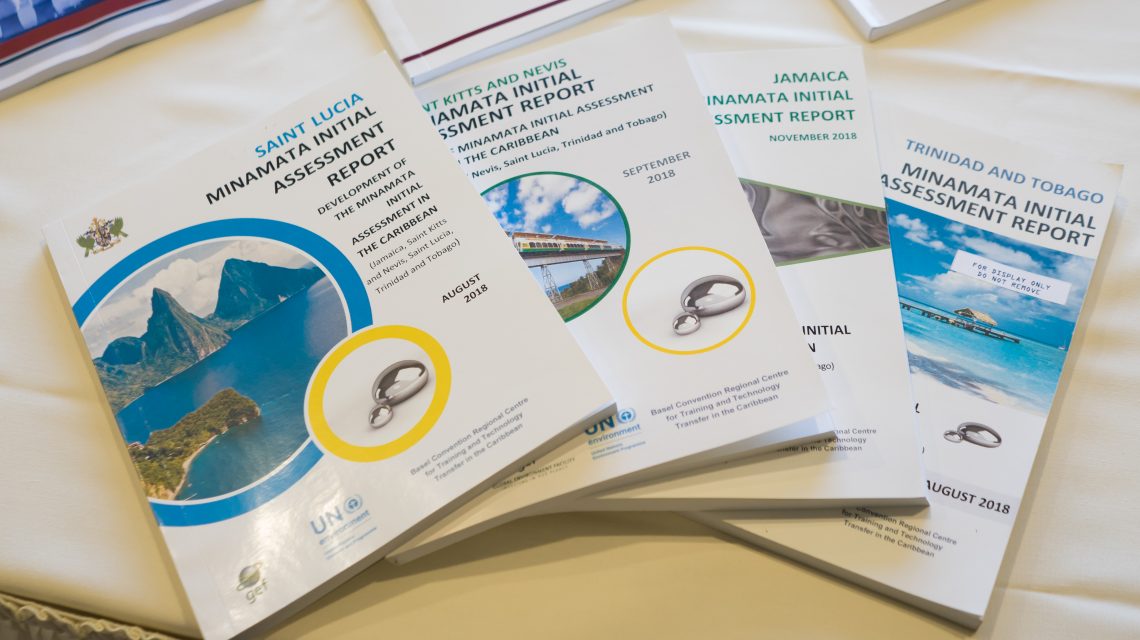
Various Reports and Documents are developed during the life-cycle of a project. These include Project Framework Documents or similar document that describes the project’s aims, expected outputs and activities and the Final Project Report which conveys the actual outcomes of the project. Developed Reports from each of the mercury projects can be found at the
read moreThe Global Programme, Implementing Sustainable Low and Non-Chemical Development in Small Island Developing States (ISLANDS), was approved by the Global Environment Facility (GEF) Council on 13 June 2019 for five (5) child projects in 27 countries from the Caribbean, Indian Ocean and Pacific Regions (GEF #10185). A sixth (6th) child project was approved in December
read more
The BCRC-Caribbean is expected to communicate its programmes of work by developing business plans that identify priority projects implementable at a regional level. In this regard, the BCRC-Caribbean has developed Business Plans in consultation with key stakeholders in the Caribbean, to prioritize and subsequently address issues of major concern in the Caribbean.
read more