
Trinidad and Tobago

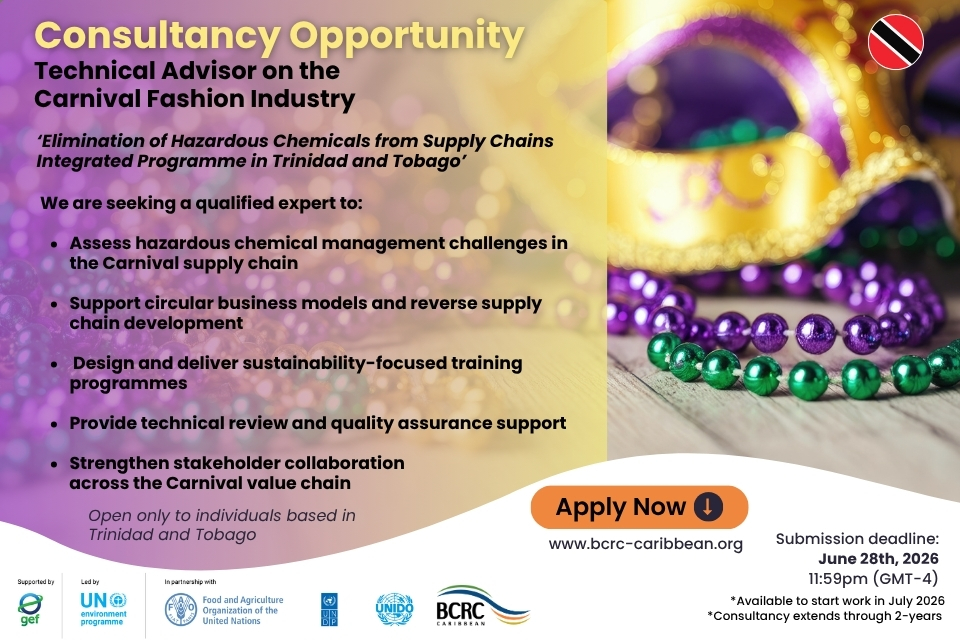
The Elimination of Hazardous Chemicals from Supply Chains Integrated Programme in Trinidad and Tobago, funded by the Global Environment Facility (GEF), seeks to transform the Carnival Fashion Industry by promoting safer chemical management, sustainable production practices, circular business models, and environmentally responsible consumption. The project aims to eliminate hazardous chemical pollution from supply chains while supporting innovation, sustainability, and long-term

read more
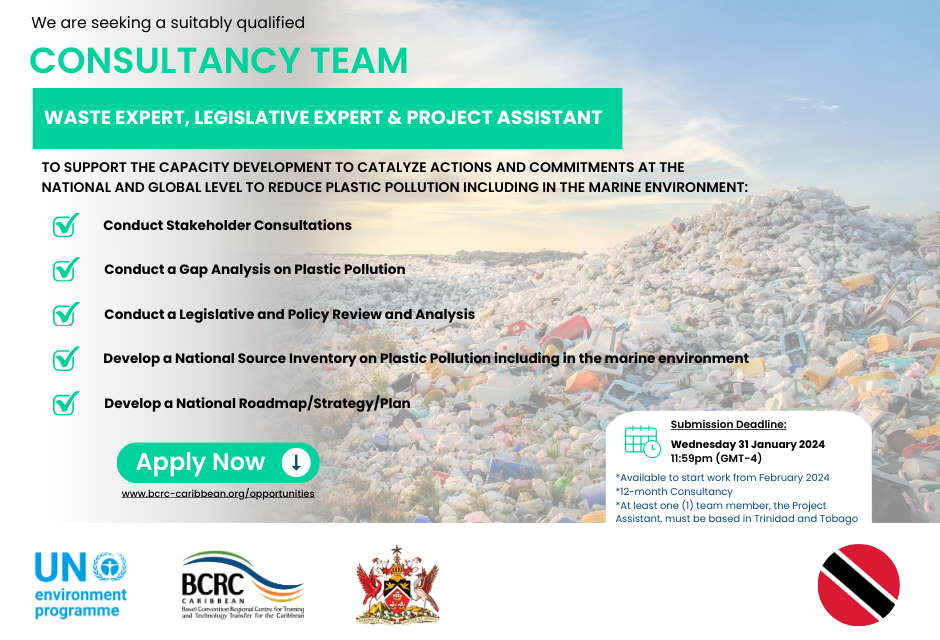
Based on the United Nations Environment Assembly (UNEA) Resolutions 1/6 “Marine plastic debris and microplastics”, 2/11 “Marine plastic litter and microplastics”, 3/7 “Marine litter and microplastics”, 4/6 “Marine plastic litter and microplastics” and 5/14 “End Plastic Pollution: Towards an international legally binding instrument” of the UNEA, the United Nations Environment Programme (UNEP) has developed this

read more

Under the “Fish Mercury Biomonitoring in the Caribbean Region” Project conducted in Antigua and Barbuda, Dominica, Grenada, Saint Lucia, Suriname, and Trinidad and Tobago, the BCRC-Caribbean developed fish consumption matrices and flyers to raise awareness of mercury in aquatic species and measures that could be taken to reduce exposure to mercury through consumption. The materials

read more

Under the Minamata Initial Assessment in Jamaica, Saint Kitts and Nevis, Saint Lucia and Trinidad and Tobago, the BCRC-Caribbean developed videos, posters and brochures to raise awareness on the sources of mercury in these countries and its dangers to human health and the environment. These were presented to national stakeholders and students through a series

read more

GEF ISLANDS

Small Island Developing States (SIDS) experience unique challenges with managing chemicals and waste due to their limited land mass, high population densities, limited resources, unique biodiversity, high risk of exposure to natural hazards and disasters, vulnerability to the effects of climate change, remoteness from global markets and small economies of scale. Most SIDS are primarily

read more

Persistent Organic Pollutants (POPs) are a group of toxic organic chemicals commonly found in some household products and chemicals, industrial chemicals and waste disposal sites and which have negative effects on human health and long-term wellness and the environment. Once released into the environment, these chemicals remain intact for long periods of time and become

read more