

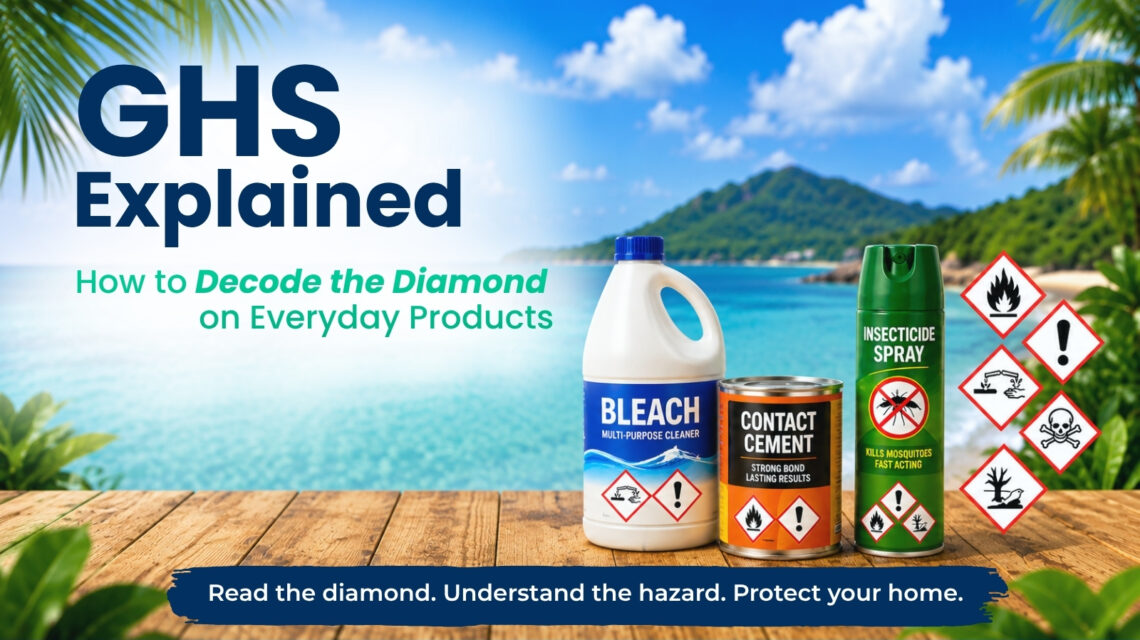
The red hazard diamonds found on products such as cleaners, adhesives and insect sprays are GHS hazard pictograms — part of a globally harmonised system for classifying and communicating chemical hazards.
Here’s how to decode them, understand the hazards and use the information on chemical labels to help keep yourself and your home safe.
Look beneath your kitchen sink and you’re likely to find them: red diamond-shaped symbols on bleach, bug spray, drain cleaners or strong adhesives. These GHS hazard pictograms are designed to communicate important hazard information at a glance. While many of us see them regularly, we may not always know what they mean or how they can help us use chemical products more safely.
This August, BCRC-Caribbean ran a public-education series called Decode the Diamond. Here’s the whole series in one five-minute read.
What is the GHS?
GHS stands for the Globally Harmonised System of Classification and Labelling of Chemicals. It is a United Nations framework that provides a harmonised approach to classifying chemical hazards and communicating them through pictograms, signal words, hazard statements and precautionary statements.
Before GHS, approaches to classifying and communicating chemical hazards could differ between countries and systems. GHS provides a common framework so that chemical hazards can be communicated more consistently around the world.
Where you’ll see it
GHS isn’t only relevant to factories and laboratories. Those red diamonds can appear on everyday products found in Caribbean homes, including household cleaners, glues and adhesives, pool chemicals, garden pesticides and aerosol insect sprays.
The system is also relevant in workplaces and across supply chains — including on chemical products moving through our ports and on the Safety Data Sheets (SDS) used to communicate detailed information about chemical hazards and safe handling.
The nine symbols
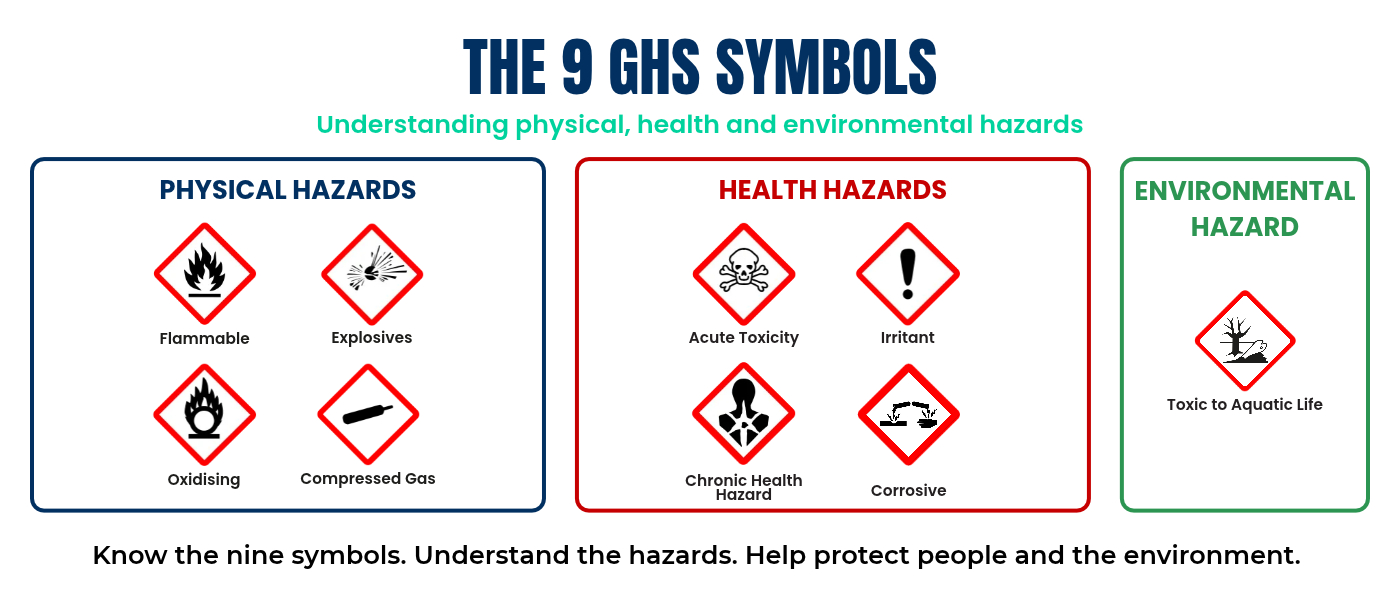
GHS uses nine hazard pictograms to visually communicate different types of chemical hazards. For easy reference, these can be broadly grouped according to the hazards they communicate: physical, health and environmental hazards.
Physical hazards include the flame, exploding bomb, flame over circle and gas cylinder pictograms. These can communicate hazards such as flammability, explosivity, oxidising properties and gases under pressure.
Health hazards include the skull and crossbones, corrosion, health hazard silhouette and exclamation mark. Depending on the classification, these can communicate hazards including acute toxicity, skin or eye damage, serious or long-term health effects, and harmful or irritant effects.
The environment pictogram, represented by a dead tree and fish, communicates hazards to the aquatic environment.
Learning to recognise these nine pictograms can help you identify important hazard information on chemical labels and understand when additional precautions may be needed.
Danger or Warning?
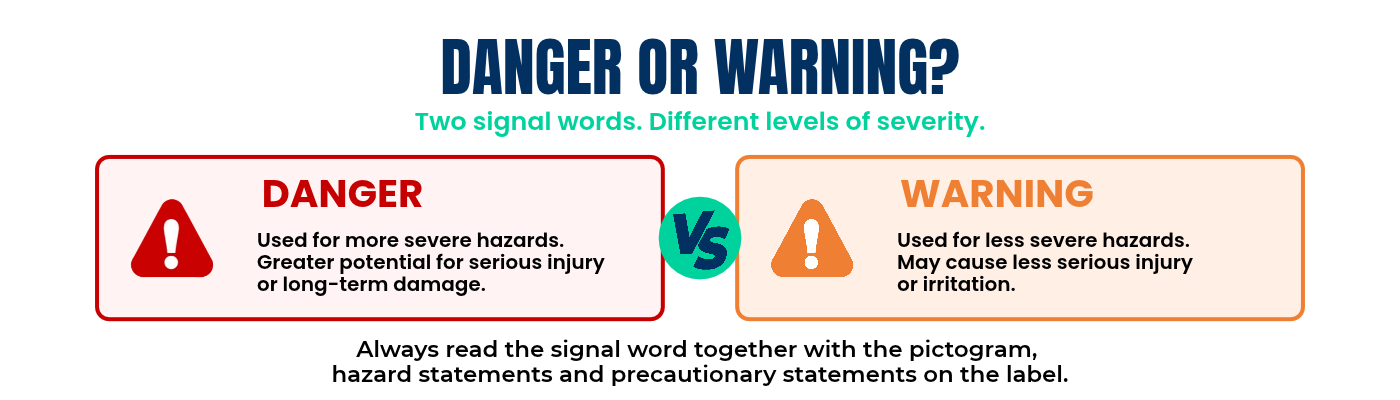
A GHS label may also include one of two signal words: “Danger” or “Warning.”
“Danger” is used for more severe hazard categories, while “Warning” is used for less severe hazard categories.
Signal words work alongside the pictograms and other information on the label. Hazard statements provide more detail about the nature and, where appropriate, degree of the hazard, while precautionary statements provide recommended measures for preventing or minimising adverse effects.
Together, these elements help you understand the hazards associated with a product and the precautions needed for safer handling and use.
In your home
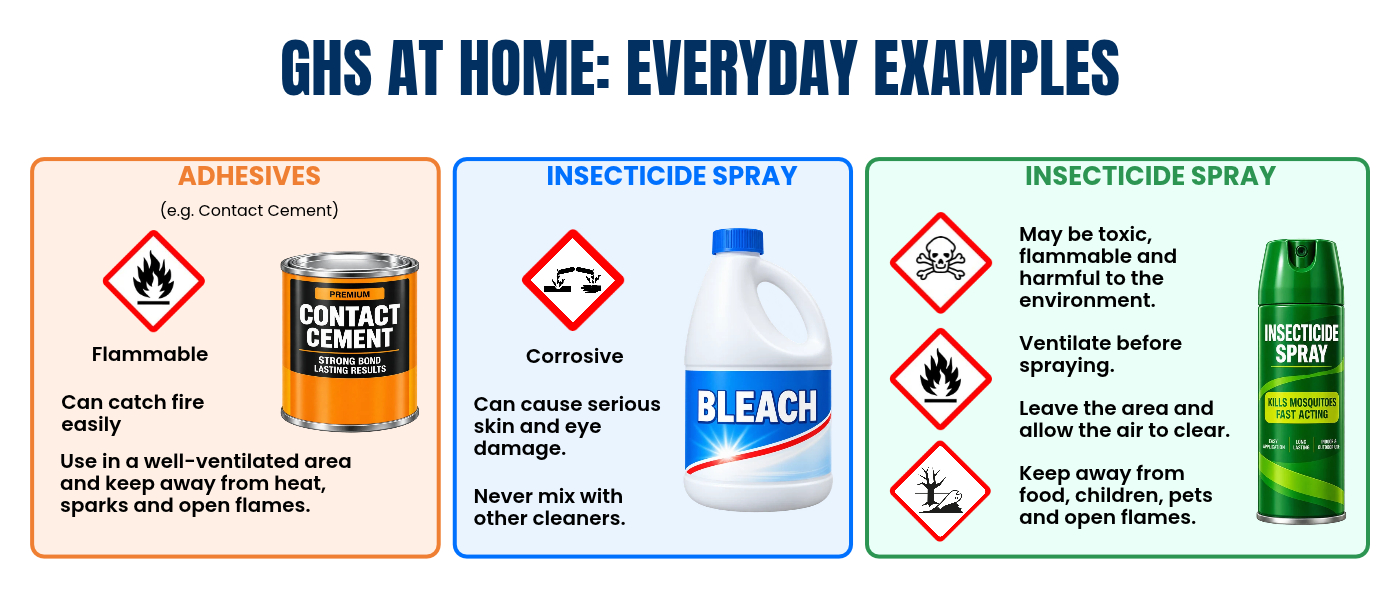
Three everyday examples show why understanding chemical labels matters.
Strong adhesives, such as some contact cements, may be classified as flammable and display the flame pictogram. Their vapours can also build up in enclosed spaces. Ensure good ventilation during use and keep the product away from heat, sparks and open flames.
Household bleach, depending on its formulation and concentration, may display the corrosion pictogram. Products carrying this classification can cause serious skin and eye damage. Bleach should never be mixed with ammonia or certain acidic cleaners, as this can release toxic gases. Use one cleaning product at a time and always follow the label instructions.
Insecticide aerosol sprays can carry pictograms indicating hazards such as flammability, acute toxicity or hazards to the aquatic environment, depending on their formulation and classification. Always check the specific product label. When using an indoor insecticide spray, follow the label instructions for ventilation and re-entry. Where directed, ventilate the area, leave after spraying and allow the air to clear. Keep products away from food, children and pets, and keep flammable aerosols away from heat, sparks and open flames.
Why it matters
For Small Island Developing States (SIDS), understanding chemical hazards is relevant across homes, workplaces and supply chains. Caribbean countries import many of the chemical products used across the region, making clear hazard communication important for workers handling chemicals at ports and workplaces, farmers using agricultural products, and families using household chemicals.
During mosquito season, for example, understanding the information on an insecticide aerosol label can help people recognise hazards and follow the appropriate precautions before, during and after use.
This awareness also complements the broader chemicals and waste work supported by BCRC-Caribbean, including its work related to the Basel, Rotterdam, Stockholm and Minamata Conventions. Together, these efforts contribute to stronger chemicals and waste management and greater awareness of chemical hazards across the region.

Learn more — for free
Want to understand GHS even better? Explore the free, interactive GHS course on BCRC-Caribbean’s Digital Learning Hub and build your understanding of GHS pictograms, chemical hazards and labels.
Take the free, interactive GHS course → BCRC - Digital Learning Hub
Read the diamond. Understand the hazard. Protect your home.