
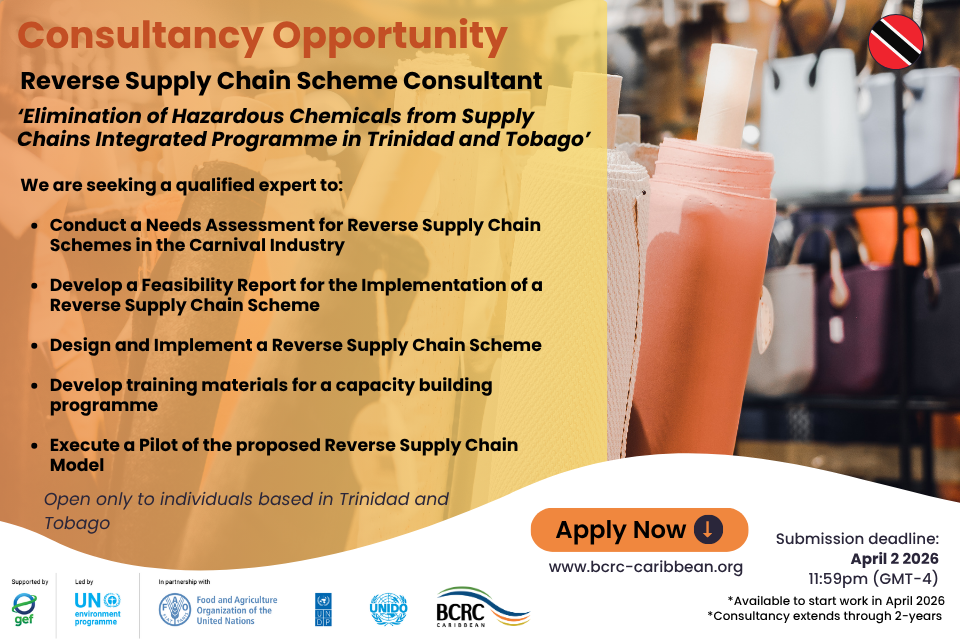
The Elimination of Hazardous Chemicals from Supply Chains Integrated Programme in Trinidad and Tobago, funded by the Global Environment Facility (GEF), seeks to influence a shift in the Carnival Fashion Design Sector to promote the use of locally sourced, sustainable materials and pollution-free approaches, as well as to create and strengthen circular and transparent supply chains.
This Integrated Programme is one of the eight child projects of the GEF 8 Integrated Programme (IP) 11 that overall focuses on both the fashion and construction industries and aims to address environmental degradation and focuses on transforming supply chains to be green, achieve zero pollution and zero waste, integrate nature-based solutions and become carbon neutral. Carnival celebrations in Trinidad and Tobago can contribute to harmful impacts to human health and the environment, given the use of materials such as feathers, plastic beads and sequins and metal wire frames that may be treated and/or contain harmful chemicals. Additionally, Carnival costumes and wear are largely single-use items, thereby contributing significantly to landfill waste. Therefore, the Integrated Programme in Trinidad and Tobago will address transformational change within the Carnival Fashion Design Sector.
The Basel Convention Regional Centre for Training and Technology Transfer for the Caribbean (BCRC-Caribbean) will act as the Executing Agency for this Integrated Programme, while the United Nations Environment Programme (UNEP) acts in the capacity of the Implementing Agency. The project is divided into four (4) components, which places specific emphasis on the following areas of supply chains:
- Design and Business Models
- Materials and Cleaner Production
- Sustainable Consumption
- Knowledge Management
Under Component 1 (Design and Business Models) of the project, activities will be undertaken to the adoption of circular business models and the reuse of costume components by mas bands, material suppliers and local artisan in the fashion and art industries, thereby facilitating business-to-business (B2B) transactions via business models that circulate materials in the economy (e.g., rental, resale, repair or remaking). Under Component 1, Output 1.2 will focus on the collection and repurposing of 10,000 Carnival costumes through a Reverse Supply Chain (RSC) scheme, with the materials obtained from consumers and fed back into design and local costume manufacture. To facilitate this output, Activity 1.2.2 will aim to ensure that an RSC Scheme system for the Carnival industry has been successfully designed and demonstrated and which increases sustainable designs through repurposing, recycling and reusing materials to reduce waste used by both consumers and Mas bands and increase environmental sustainability in supply chain life cycles.
In this regard, the BCRC-Caribbean is seeking to recruit a suitably qualified and experienced Reverse Supply Chain (RSC) Scheme Consultant to fulfil this activity.
Open to: Individuals based in Trinidad and Tobago
Consultancy Duration: Two (2) years
Expected Consultancy start date: March 2026
Language: The proposal, including all supporting documentation, shall be written in English
Deadline for submitting proposals: Thursday 2nd April 2026 11:59pm (GMT-4) [DEADLINE EXTENDED]
Applications must be sent to submissions@bcrc-caribbean.org. The subject of the email should clearly state the consultancy for which you are bidding in accordance with the following template:
BCRC#11176_2026_001_ LastNameFirstName