
The Elimination of Hazardous Chemicals from Supply Chains Integrated Programme in Trinidad and Tobago, funded by the Global Environment Facility (GEF), seeks to transform the Carnival Fashion Design Sector through the adoption of safer, more sustainable materials, pollution prevention measures, and circular supply chains. The project is one of eight child projects under GEF-8 Integrated Programme 11, which focuses on eliminating hazardous chemicals from supply chains in the fashion and construction sectors while promoting zero pollution, zero waste, and carbon-neutral approaches. The Basel Convention Regional Centre for Training and Technology Transfer for the Caribbean (BCRC-Caribbean) serves as the Executing Agency, while the United Nations Environment Programme (UNEP) serves as the Implementing Agency.
The project comprises four key components:
- Design and Business Models
- Materials and Cleaner Production
- Sustainable Consumption
- Knowledge Management
Under Component 3: Sustainable Consumption, the project aims to identify and promote sustainable alternative materials sourced through secondary markets that can be integrated into Carnival costume production. These materials may include agricultural by-products, recovered materials, manufacturing offcuts, and other sustainable resources that are ethically sourced, non-toxic, free from hazardous chemicals, and environmentally sound.
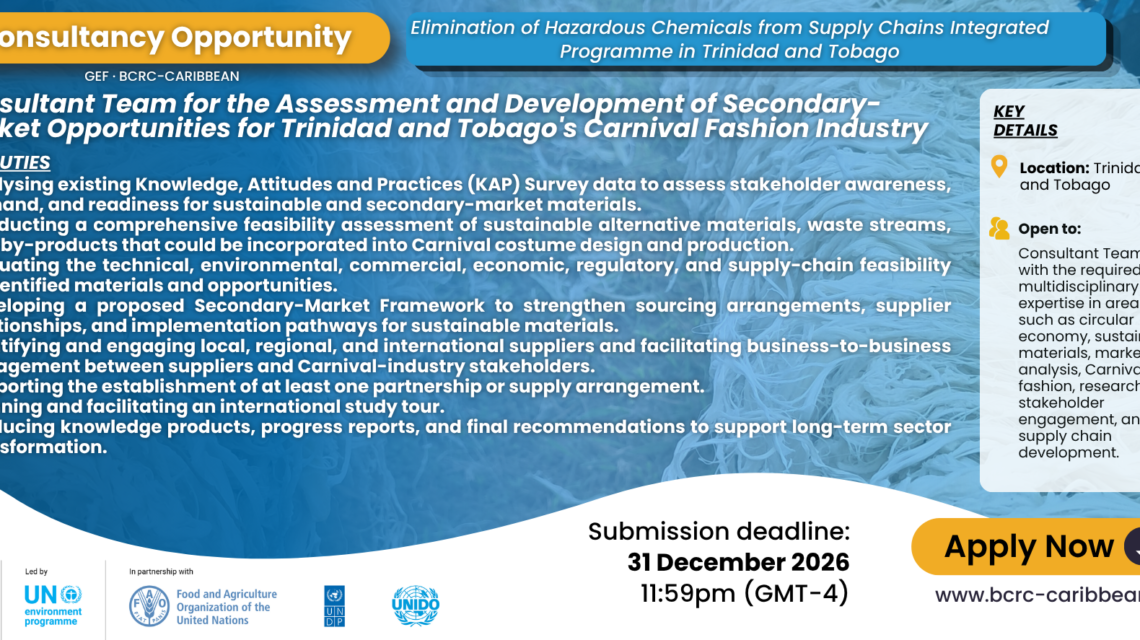
To support this work, BCRC-Caribbean is seeking to engage a suitably qualified and experienced Consultant Team for the Assessment and Development of Secondary-Market Opportunities for Trinidad and Tobago’s Carnival Fashion Industry. The Consultant Team will work closely with Carnival stakeholders, suppliers, designers, mas band leaders, artisans, and other project consultants to identify viable secondary-market opportunities, facilitate market linkages, and promote the adoption of sustainable materials in the Carnival sector.
Key responsibilities include:
- Analysing existing Knowledge, Attitudes and Practices (KAP) Survey data to assess stakeholder awareness, demand, and readiness for sustainable and secondary-market materials.
- Conducting a comprehensive feasibility assessment of sustainable alternative materials, waste streams, and by-products that could be incorporated into Carnival costume design and production.
- Evaluating the technical, environmental, commercial, economic, regulatory, and supply-chain feasibility of identified materials and opportunities.
- Developing a proposed Secondary-Market Framework to strengthen sourcing arrangements, supplier relationships, and implementation pathways for sustainable materials.
- Identifying and engaging local, regional, and international suppliers and facilitating business-to-business engagement between suppliers and Carnival-industry stakeholders.
- Supporting the establishment of at least one partnership or supply arrangement between suppliers and Carnival-sector stakeholders.
- Planning and facilitating an international study tour to expose stakeholders to successful examples of sustainable materials, circular production systems, and secondary-market development.
- Producing knowledge products, progress reports, and final recommendations to support long-term sector transformation.
Open to: Consultant Teams with the required multidisciplinary expertise in areas such as circular economy, sustainable materials, market analysis, Carnival fashion, research, stakeholder engagement, and supply chain development.
Consultancy Duration: Approximately eighteen (18) months, with a tentative start date of February 2027 and a tentative end date of July 2028.
Language: English.
Deadline for Submission of Proposals: 31 December 2026 at 11:59 p.m. (GMT-4).
Applications must be submitted via email to submissions@bcrc-caribbean.org, clearly indicating the consultancy reference number and title in the subject line: BCRC#11176_2026_005 Consultant Team for the Assessment and Development of Secondary-Market Opportunities for Trinidad and Tobago’s Fashion Industry.
Resources: